

Why Your Sport Bottle Smells Even After You Wash the Body (The Valve Is the Problem)
The part you're not cleaning
You rinse your bottle after every ride. You run it through the dishwasher twice a week. And it still has that faint, stale smell that makes you hold it slightly away from your face before drinking. If that sounds familiar, you're not being lazy — you're just cleaning the wrong part.
The body of a sport bottle is easy to reach and easy to rinse. The valve is not. And that's exactly where the problem lives.
What's actually happening inside a sport nozzle
A squeeze-style sport nozzle — the kind you push open with your lips and squeeze to drink — works because of a self-sealing valve: a small, flexible mechanism that closes when you're not actively drinking, keeping the bottle leak-proof in your bag or bike cage. That sealed channel is the whole point of the design. It's also a near-perfect environment for residue to sit, undisturbed, between uses.
Every time you drink a protein shake, a sports drink, or even plain water with electrolyte powder, a thin film of that liquid gets trapped inside the valve channel. When you rinse the body and leave the nozzle assembled, that film stays exactly where it is — warm, damp, and sealed off from the air. The smell you're noticing is the predictable result.
The valve isn't dirty because you're careless. It's dirty because the design of most sport nozzles makes it genuinely difficult to clean without disassembling them. Most people don't know that disassembly is even possible.
Why a bottle brush doesn't solve this
Running a brush through the nozzle opening cleans the outer surface of the tip. It does almost nothing for the interior valve channel, because the valve is closed. You'd need to push past the seal — and even then, a standard brush isn't shaped for the geometry inside a squeeze nozzle.
The same logic applies to a quick rinse under the tap. Water flows over the nozzle, not through the sealed interior. The residue stays put.
This is why your bottle can pass a visual inspection and still smell. The problem isn't visible from the outside, and it won't respond to surface-level cleaning.
How to actually clean a sport valve
The approach depends on whether your nozzle disassembles. If it does, that's where you start — every time.
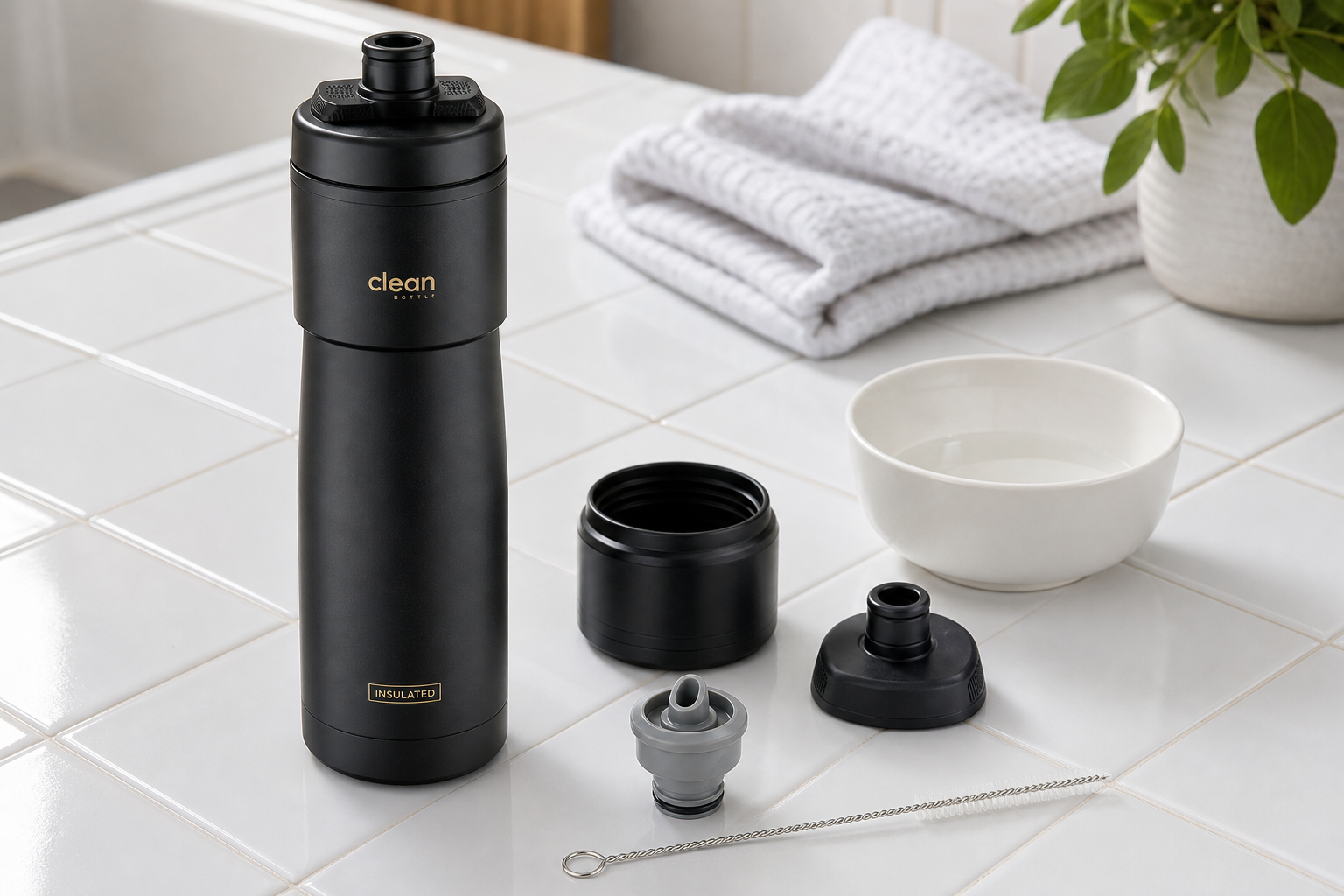
- Pull the nozzle apart. On bottles with a disassembling nozzle, the tip and valve mechanism separate from the main cap. Do this before any cleaning session, not after.
- Soak the components. A solution of warm water and a small amount of white vinegar, or a dedicated bottle-cleaning tablet dissolved in water, works well for breaking down biofilm and residue. Let the disassembled pieces sit for several minutes rather than just rinsing them.
- Use a thin straw brush or pipe cleaner. Once soaked, a narrow brush can reach the interior of the valve channel and the small crevices inside the cap threads. These brushes are inexpensive and widely available — worth keeping next to your dish soap.
- Rinse thoroughly and let everything air-dry fully before reassembling. Reassembling while components are still damp traps moisture and restarts the cycle. Stand the pieces upright or lay them on a drying rack with airflow.
If your nozzle doesn't disassemble at all, your realistic options are limited to soaking, thin brushes, and replacement caps on a regular schedule. Some residue will always be out of reach.
What to look for in a bottle designed to stay clean
The valve problem isn't inevitable — it's a design problem, and some bottles solve it better than others. When you're evaluating a sport bottle for long-term hygiene, a few features matter more than most people realize:
- A nozzle that actually disassembles. Not just a removable cap, but a nozzle where the valve mechanism itself comes apart for cleaning. This is the single most important feature for preventing odor buildup.
- A rotating lock on the valve. A lockable valve keeps the bottle leak-proof in transit, but it also means the seal stays cleaner between uses — less chance of outside contaminants entering the nozzle.
- BPA-free materials throughout. This matters for the valve and cap components specifically, since those are the parts in direct contact with your mouth and the parts most likely to absorb odors over time if made from lower-quality materials.
- A squeeze design with a self-sealing valve. Counterintuitively, a well-engineered self-sealing valve is easier to clean when it disassembles, because the mechanism is designed to come apart — rather than being a single molded piece with no access points.
For anyone who uses their bottle daily for workouts, cycling, or commuting, these aren't nice-to-haves. They're the difference between a bottle that stays genuinely clean and one that gets replaced every few months because the smell never fully goes away. If you want a deeper look at what separates a well-designed reusable bottle from one that just looks good on a shelf, the comprehensive guide to reusable water bottle hygiene and sustainability covers the full picture.
The insulation factor
There's one more thing worth knowing: insulated bottles hold temperature longer, which means the liquid inside stays cold (or hot) for extended periods. That's the obvious benefit. The less obvious one is that cold liquid is less hospitable to the bacteria and mold that cause odor than liquid sitting at ambient temperature. An insulated bottle that's also easy to clean at the valve level is a meaningfully better hygiene setup than a single-wall bottle that's difficult to disassemble.
Double-wall insulation also means the exterior stays dry — no condensation pooling around the base or soaking your bag — which removes another common source of mildew smell that people often misattribute to the inside of the bottle.
The Clean Bottle Insulated Stainless Steel Water Bottle
The matte black Clean Bottle Insulated Stainless Steel Water Bottle is built around exactly this problem. The nozzle disassembles for a real clean — not just a rinse over the tip — and the self-sealing valve with rotating lock means the bottle stays leak-proof between uses without trapping residue in a permanently sealed channel. Double-wall insulation keeps drinks cold through a full training session, and the squeeze design means you can drink without breaking stride on a ride or mid-set at the gym. It fits standard bike cages and backpack holders, and the BPA-free construction runs through the cap and nozzle components, not just the body.
It's a mid-range bottle built for people who actually use it hard — and want it to still smell fine three months from now.
The nozzle disassembles for a real clean — not just a rinse. Take a closer look at how the Clean Bottle Insulated Stainless Steel Water Bottle is built.
Frequently Asked Questions
How often should I fully disassemble and clean my sport bottle nozzle?
If you're using the bottle daily — especially with anything other than plain water — disassembling and cleaning the nozzle after every use is the most effective approach. At a minimum, do a full disassembly clean every two to three days. Residue builds up faster than most people expect, and waiting until you notice a smell means the biofilm is already established.
Can I put my sport bottle nozzle in the dishwasher instead of hand-cleaning it?
It depends on the bottle's dishwasher rating, but even dishwasher-safe nozzles benefit from being disassembled first. A dishwasher cleans surfaces it can reach — a fully assembled valve has interior channels the water jets won't penetrate. Disassemble, then run the components on the top rack if they're rated for it.
What's the best way to get rid of an existing smell in a sport bottle valve?
Disassemble the nozzle completely and soak all components in a solution of warm water and white vinegar for at least fifteen to twenty minutes. Follow with a scrub using a thin straw brush, a thorough rinse, and — critically — a complete air-dry before reassembling. For stubborn odors, a bottle-cleaning tablet designed for hydration gear can help break down the biofilm that's causing the smell. Skipping the full dry before reassembly is the most common reason the smell returns quickly.
Does using an insulated bottle really make a hygiene difference, or is that just a selling point?
It's a genuine factor, not just marketing. Bacteria and mold that cause odor thrive in warm, moist environments. A double-wall insulated bottle keeps liquid colder for longer, which slows that process compared to a single-wall bottle where the contents warm to room temperature quickly. It's not a substitute for cleaning the valve properly, but it does reduce how fast residue becomes a problem between cleaning sessions.