

What Is the Safest Water Bottle Material for Everyday Use? An Honest Breakdown
The water bottle aisle shouldn't require a chemistry degree, but somehow it does. You pick up a bottle, flip it over, and find yourself staring at a string of resin codes and marketing claims — BPA-free, food-grade, non-toxic — that tell you what the bottle isn't, not what it actually is. Meanwhile, a quick internet search turns up contradictory takes from wellness bloggers, plastics industry spokespeople, and everyone in between.
So let's cut through it. Here's what the main bottle materials actually mean for your health, your cleaning routine, and how long your bottle will realistically last.
Plastic: The Most Common, and the Most Complicated
Plastic bottles dominate the market because they're cheap to make and light to carry. The problem isn't plastic as a category — it's that the category is enormous, and not all plastics behave the same way.
The concern most people know about is BPA (bisphenol A), a chemical used to harden certain plastics that has been linked to hormonal disruption. Many brands responded by removing BPA from their products, which is genuinely good. But some of the replacement chemicals — BPS, BPF, and others in the bisphenol family — are now under similar scrutiny. A bottle labeled BPA-free isn't automatically free of all concern; it just means that one specific compound was removed.
There's also the heat problem. When plastic bottles are left in a hot car, run through a dishwasher on high heat, or used repeatedly over time, the material can degrade and release trace compounds into whatever you're drinking. This doesn't happen overnight, but it's a cumulative issue worth thinking about if you're refilling the same bottle every day.
Cleaning is the other sticking point. Plastic scratches easily, and those micro-scratches become hiding spots for bacteria and mold — especially in bottles with narrow necks that are hard to scrub thoroughly. If you've ever pulled a plastic bottle out of your gym bag and caught a whiff of something off, you know exactly what this means in practice.
Glass: Clean and Inert, but Fragile by Nature
Glass is chemically inert, which means it doesn't leach anything into your drink regardless of temperature, acidity, or how long the liquid sits. It won't absorb odors or flavors, and it's genuinely easy to clean — you can see every corner of the interior and scrub it without worrying about scratching the surface.
The trade-off is obvious: glass breaks. A glass bottle dropped on a tile floor or concrete path is a liability, not just an inconvenience. Most glass bottles address this with silicone sleeves, but that adds weight and doesn't fully eliminate the risk. For commuting, hiking, or gym use, glass is a tough sell. For desk use where it stays put, it's a reasonable choice.
Glass also offers no insulation on its own. If you want your cold brew to stay cold through a morning meeting, you'd need a double-walled glass bottle — which exists, but adds cost and weight to an already heavy material.
Stainless Steel: The Practical Middle Ground
For most people who use a bottle every single day, stainless steel is where the balance tips. It's durable enough to take a knock without shattering, it doesn't leach chemicals into your drink, and double-wall vacuum insulation keeps temperatures stable for hours — something neither plastic nor standard glass can do.
The grade of steel matters, though. 18/8 stainless steel (also written as 304 stainless steel) is the food-safe standard — the "18" refers to chromium content, which resists corrosion, and the "8" refers to nickel, which adds durability. It's the same grade used in commercial kitchens and food processing, and it's what you want in a bottle you're filling with everything from plain water to coffee to citrus-infused drinks.
The one legitimate knock on stainless steel has traditionally been cleaning. Narrow-necked bottles trap moisture and residue at the bottom, and if you can't reach that far with a brush, buildup is inevitable. This is where design matters as much as material.
Why the Bottom of Your Bottle Is the Real Hygiene Problem
Think about where residue actually collects in a water bottle. It's not at the top — it's at the bottom, where water pools, protein shake sediment settles, and fruit pulp sits if you've been infusing. Most bottles give you one way in: through the top. You can shake in some cleaning solution, run a brush as far as it reaches, and hope for the best.
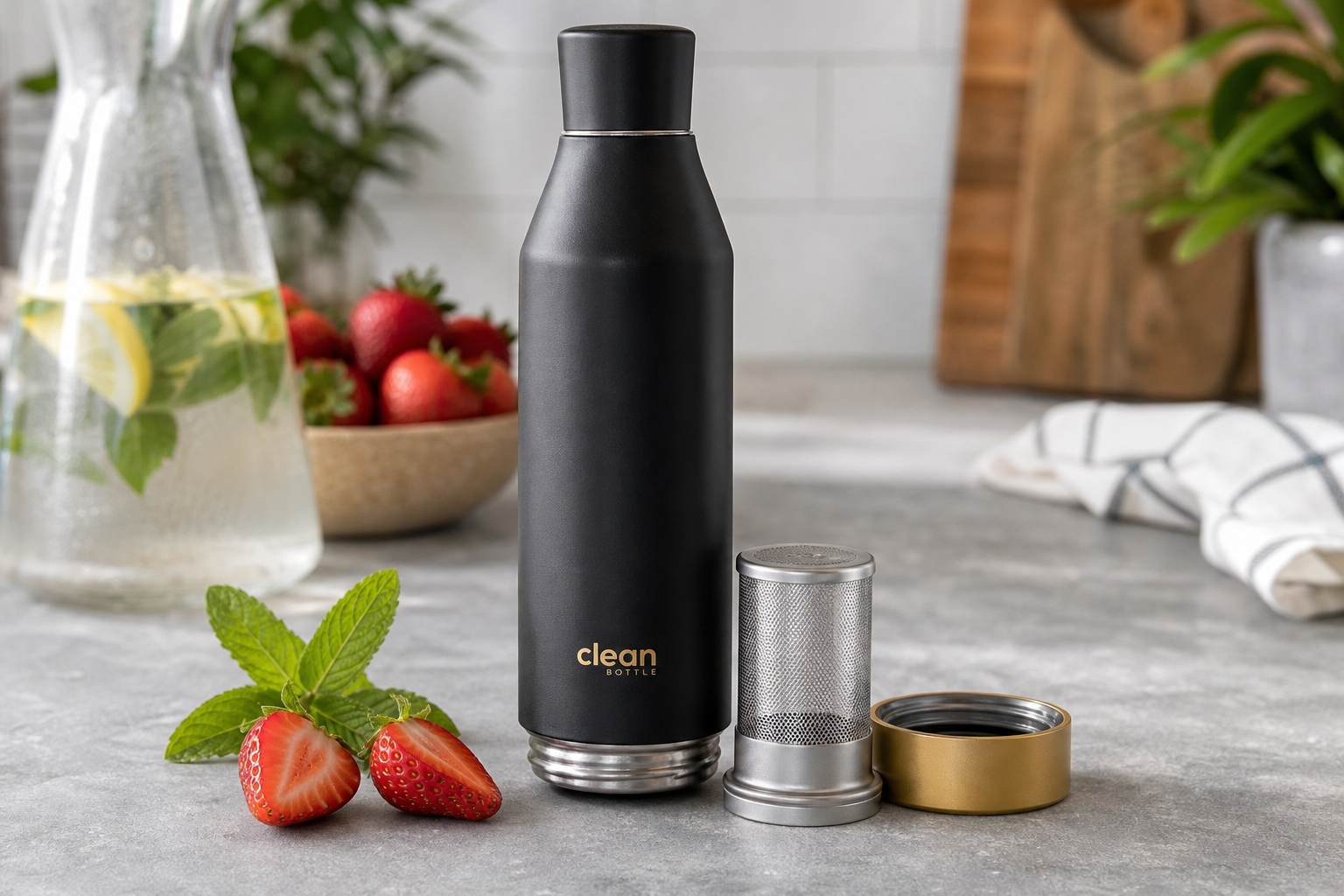
The Clean Bottle 17 Oz Insulated Water Bottle solves this differently. Its patent-pending removable bottom cap means you can open the bottle from both ends — which turns a frustrating cleaning task into a straightforward one. No more guessing whether your brush reached the bottom. No more residue quietly building up where you can't see it.
The bottle is built from 18/8 stainless steel with a BPA-free construction, and it features double-wall vacuum insulation to keep drinks hot or cold for hours. The included bottom-loading fruit infuser keeps ingredients fully submerged, so you actually get flavor in your water rather than a few sad fruit pieces floating at the top. It's the kind of detail that sounds small until you've used a top-loading infuser and watched your cucumber slices bob uselessly above the waterline.
The design was featured on Shark Tank and secured a deal with Mark Cuban — not because it was a novelty, but because it addressed a real, everyday problem that millions of bottle owners deal with and mostly ignore.
If you want a deeper look at how to clean a water bottle properly and avoid mold and bacteria, that's worth reading alongside this — the material you choose and how you clean it work together.
So, Which Material Is Actually Safest?
Honest answer: for most people, most of the time, 18/8 stainless steel with a BPA-free construction checks the most boxes. It doesn't leach, it survives daily use, it insulates, and it doesn't require you to baby it the way glass does.
That said, the safest bottle is the one you actually clean thoroughly and regularly. A premium stainless steel bottle that never gets properly cleaned is a worse choice than a glass bottle you rinse out daily. Material is the foundation — your cleaning habits are the rest of the structure.
If you're also thinking about how your hydration habits connect to how you feel day-to-day, the post on how water affects your brain and cognitive function is a good read. What you drink from matters, but so does how consistently you drink.
See how the Clean Bottle 17 Oz is built — 18/8 stainless steel, BPA-free, and designed to stay clean inside. Shop the Clean Bottle 17 Oz at cleanbottle.com and see what a bottle designed around hygiene actually looks like.
Frequently Asked Questions
Is 18/8 stainless steel safe for hot drinks like coffee and tea?
Yes. 18/8 (304) stainless steel is food-safe and does not leach chemicals when exposed to heat. It's the same grade used in commercial food preparation and is widely considered one of the safest materials for hot beverages. Double-wall vacuum insulation also means the outer surface stays cool to the touch even when the contents are hot.
Does BPA-free mean a plastic bottle is completely safe?
Not necessarily. BPA-free means one specific compound — bisphenol A — has been removed, but some replacement chemicals in the bisphenol family are still being studied for similar concerns. It's a meaningful label, but it's not a blanket safety guarantee. If chemical leaching is your primary concern, stainless steel or glass are more straightforward choices.
Why does the bottom of a water bottle get so dirty?
Residue from drinks — especially protein shakes, fruit infusions, coffee, or anything other than plain water — settles at the bottom where moisture collects and doesn't fully evaporate. In a standard single-opening bottle, a brush often can't reach the very bottom effectively, which allows bacteria and mold to build up over time. A bottle with a removable bottom eliminates this problem by giving you direct access to clean the entire interior.
Can I use a stainless steel bottle for acidic drinks like lemon water or citrus infusions?
18/8 stainless steel is resistant to corrosion and handles mildly acidic drinks like citrus-infused water or fruit teas well for everyday use. It's one of the reasons food-grade stainless steel is used broadly in food and beverage applications. Just make sure to clean the bottle promptly after use rather than leaving acidic liquids sitting in it for extended periods.