

Insulated Mug vs. Insulated Tumbler: How to Pick the Right One for How You Actually Drink
Most people pick a travel cup the same way they pick a phone case: grab whatever looks good, figure out the rest later. Then they spend six months drinking lukewarm coffee from a tumbler that keeps sliding off their desk, or hauling a handled mug through a commute bag that wasn't designed to hold it.
The mug vs. tumbler question sounds trivial. It isn't. The format you choose shapes how you drink, where you drink, and whether your beverage is still at the right temperature when you finally get to it. So let's actually sort this out.
The Core Difference (It's More Than Just the Handle)
Yes, a mug has a handle and a tumbler doesn't. But that single design choice ripples into everything else — how stable it is on a surface, how it fits in a bag or cup holder, how you hold it when you're moving, and even how much you can comfortably drink in one sitting.
A mug is built for stillness. You set it down, you pick it up by the handle, you set it down again. It's a desk companion, a bedside ritual, a slow Saturday morning. A tumbler is built for motion. It fits a cup holder, it slides into a bag pocket, you grip it with a full hand and keep walking.
Neither is better. They're just optimized for different versions of your day.
When a Mug Makes More Sense
If most of your drinking happens at a desk, a kitchen table, or anywhere you're sitting still for a stretch of time, a mug is the right call. The handle keeps the exterior of the vessel from heating up in your hand, and the squat, stable shape means you're not knocking it over when you reach for your keyboard.
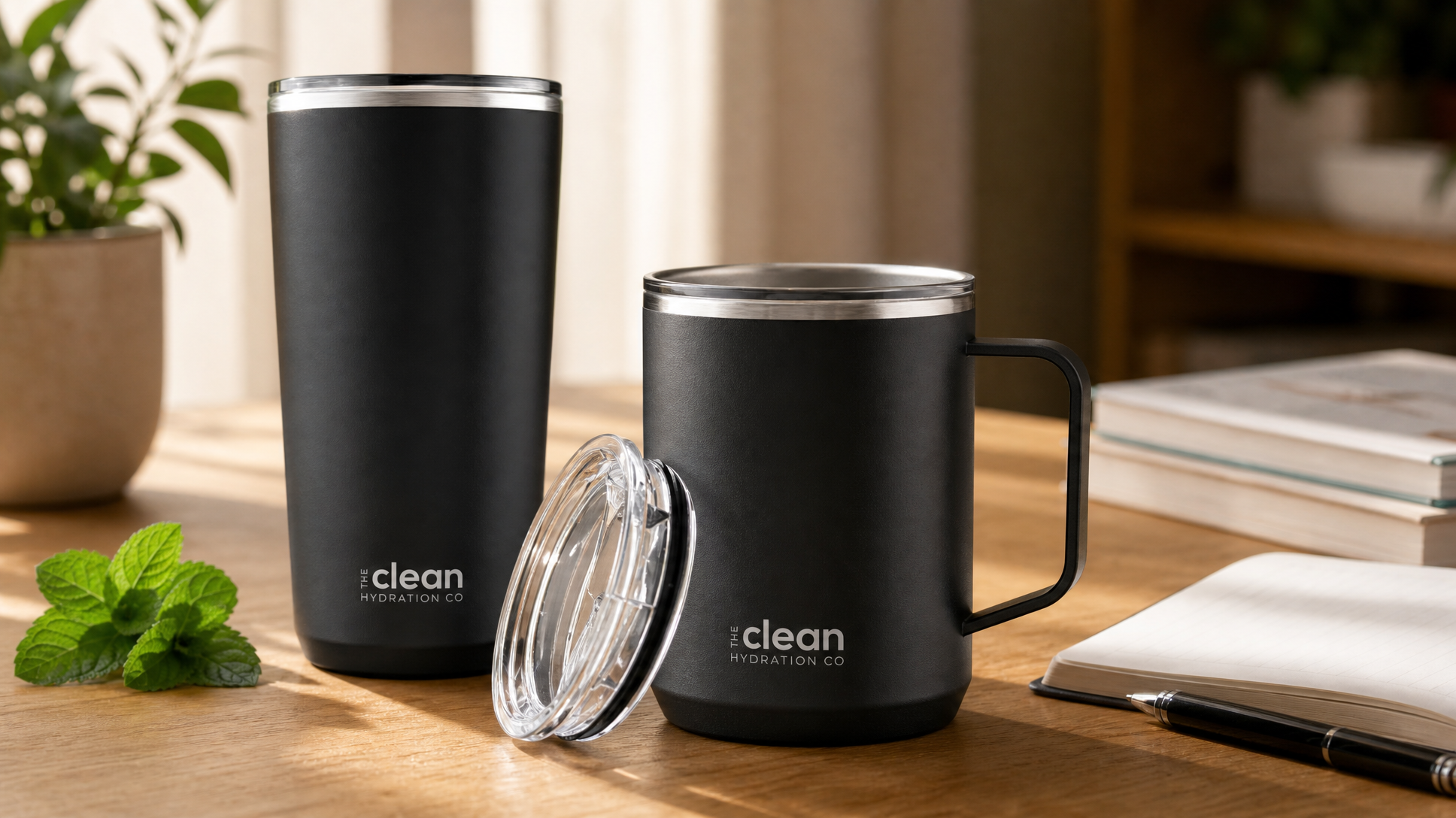
The Ceramic Lined Insulated Coffee Mug with Lid - 12oz | Clean Hydration Co. is a good example of what a well-designed insulated mug actually looks like: a matte black stainless steel body with a sturdy integrated handle, double-wall vacuum insulation to keep drinks hot or cold for hours, and a CeraTech™ ceramic interior that eliminates any metallic aftertaste. At 12oz, it's sized for a proper mug's worth of coffee — not a travel-sized sip, not an oversized bucket. It's the right amount for a focused morning or a mid-afternoon reset at your desk.
The lid matters here too. An insulated mug with a lid keeps your drink hot longer even when you're not actively drinking — which is exactly what happens when you get pulled into a meeting ten minutes after you pour.
One honest trade-off: the handle adds width, so a 12oz mug won't fit most standard car cup holders. If your commute involves a vehicle, keep that in mind.
When a Tumbler Is the Better Pick
If you're moving — commuting, running errands, working out, or just carrying your drink from room to room — a tumbler wins. The handleless, cylindrical shape is designed to be gripped with a full hand, tucked under an arm, dropped into a bag, or slotted into a car cup holder without a second thought.
The The Clean Hydration Company 20oz Ceramic Lined Insulated Coffee Tumbler fits that use case well. It's a sleek, matte black stainless steel tumbler with the same CeraTech ceramic interior as the mug — so your coffee tastes like coffee, not like the inside of a metal flask. The 20oz capacity is a meaningful step up from the mug: enough for a full thermos's worth of coffee or a generous cold brew over ice, which makes it practical for longer stretches between refills.
The clear lid sits flush at the top and the straight-sided profile means it travels cleanly. If you're the kind of person who makes one big pour in the morning and wants it to last through a commute and the first two hours of work, this is the format for you.
The one thing you give up with a tumbler: it's less comfortable to hold for long sessions at a desk, because you're gripping the full body of the vessel rather than a handle. For slow desk drinking, that gets old.
The 12oz vs. 20oz Question
Capacity is worth thinking about separately from the mug/tumbler format, because it's the other variable that changes your experience day to day.
12oz is a standard mug pour. It's the right size if you drink your coffee relatively quickly, prefer a fresh cup over a lukewarm one that's been sitting, or want something that doesn't feel oversized on a small desk or nightstand. It's also lighter to carry.
20oz is for people who nurse their drink, want fewer refill trips, or are using the vessel for cold drinks where you want room for ice. If your morning routine involves making one big pour and then getting on with your day, 20oz removes the friction of having to stop and refill.
Neither size is universally right. It depends on your pace and your habits — not on which number sounds more impressive.
The Ceramic Interior: Why It Actually Matters
Both the mug and the tumbler use a ceramic-lined interior — and if you've ever taken a sip of coffee from a plain stainless steel bottle, you know why that's worth calling out. Bare stainless steel can impart a faint metallic taste, especially with acidic drinks like coffee or tea. Ceramic doesn't react with your beverage, so what you taste is just the drink itself.
It also means you're not dealing with odor absorption over time, which is the slow death of a lot of reusable drinkware. A ceramic interior is easier to keep genuinely clean. For anyone who takes their coffee seriously — or who's had to throw out a bottle because it permanently smelled like yesterday's protein shake — this is a real functional difference, not just a marketing point.
The FDA classifies food-contact ceramics under its materials safety framework, and ceramic coatings used in drinkware are generally recognized as non-reactive with food and beverages when properly manufactured.
A Quick Decision Framework
- You drink mostly at a desk or table → Go with the 12oz mug. The handle, the size, and the stability are all built for that context.
- You're always moving — commuting, errands, gym → The 20oz tumbler fits a cup holder, a bag, and a full hand.
- You want one vessel for both hot morning coffee and cold afternoon drinks → The 20oz tumbler's larger capacity handles ice better.
- You want to replace your ceramic kitchen mug with something insulated → The 12oz mug is the closest like-for-like swap, with the bonus of keeping your drink hot far longer.
- You care about taste above all → Both have the ceramic interior, so you're covered either way. Pick based on format.
If you want to go deeper on daily hydration habits and how your vessel choice fits into them, our guide on how much water to drink daily is worth a read alongside this one.
The Bottom Line
The best insulated mug or tumbler isn't the one with the most features — it's the one that fits how you actually move through your day. Get that match right, and you'll stop reheating your coffee at 11am. Get it wrong, and even the best vacuum insulation in the world won't save you.
Browse the full insulated mug and tumbler lineup to find your fit — both are currently on sale.
Frequently Asked Questions
Can I use an insulated tumbler for cold drinks as well as hot coffee?
Yes — double-wall vacuum insulation works in both directions. It slows heat transfer regardless of whether your drink is hotter or colder than the surrounding air, so a tumbler that keeps coffee hot will also keep iced drinks cold. The 20oz tumbler's larger capacity also gives you room to add ice without losing too much drink volume.
Will the ceramic interior chip or crack with regular use?
Ceramic-lined interiors in quality insulated drinkware are designed for daily use, but like any ceramic surface, they can be damaged by drops or impacts — especially hard drops onto concrete or tile. Normal hand-washing and everyday use shouldn't cause issues. Avoid using abrasive scrubbers on the interior, and check the product's care instructions for specifics.
Does the 12oz mug fit in a standard car cup holder?
Because the mug has a handle, it typically does not fit standard car cup holders, which are designed for cylindrical vessels. If you need something that works in a cup holder, the 20oz tumbler's handleless, straight-sided design is the better choice for commuting.
How do I clean a ceramic-lined insulated mug or tumbler?
Hand-washing with warm water and a mild dish soap is generally the recommended approach for insulated drinkware — harsh dishwasher cycles can degrade the vacuum seal over time. For the ceramic interior, a soft bottle brush works well. For more detailed cleaning guidance, our post on how to clean your water bottle properly covers the key steps.