

Leakproof Travel Mug with Straw: What the Lid Design Actually Needs to Do
You've been there: bag on your shoulder, coffee in hand, and somewhere between the car and the office your tumbler decides to redecorate the inside of your tote. The straw channel leaked. Or the flip-top didn't seat properly. Or the lid just wasn't as spill-resistant as the product page implied.
A travel mug with a straw sounds simple. In practice, the lid is the most mechanically demanding part of the whole design — and most shoppers don't know what to look for until something goes wrong. So let's fix that.
Why the Lid Is the Weak Link
The body of a tumbler is relatively forgiving. Double-wall vacuum insulation is a well-understood technology, and a stainless steel cylinder doesn't have many ways to fail. The lid, though, has to do several things simultaneously: seal against liquid under pressure, accommodate a straw without creating a leak path, survive daily removal and reattachment, and open easily enough that you'll actually use it one-handed while driving.
That's a lot to ask of a piece of plastic that costs a fraction of the total product. It's also why two tumblers can look almost identical on a shelf and perform completely differently in a bag.
The Three Things a Genuinely Leakproof Straw Lid Has to Get Right
1. The Straw Channel Seal
The straw hole is the most obvious leak point, and it's the one most commonly underengineered. A well-designed straw channel fits the straw snugly enough that liquid can't migrate around the outside of it — but not so tightly that the straw deforms or becomes difficult to seat. The fit needs to account for the fact that the straw will be removed, rinsed, and reinserted dozens of times.
What you're looking for: a gasketed or precision-molded straw port that grips the straw consistently, not a loose hole with extra clearance. If you can wiggle the straw side to side with any real play, that's a gap liquid will find when the mug tips.
2. The Flip-Top Closure Mechanism
The flip-top lid exists to cover the straw opening when you're not drinking — protecting against spills and keeping debris out. But a flip-top that doesn't lock positively closed is just decorative. The closure needs to snap shut with enough resistance that it won't pop open from the pressure of a bag pressing against it or from the tumbler landing on its side.
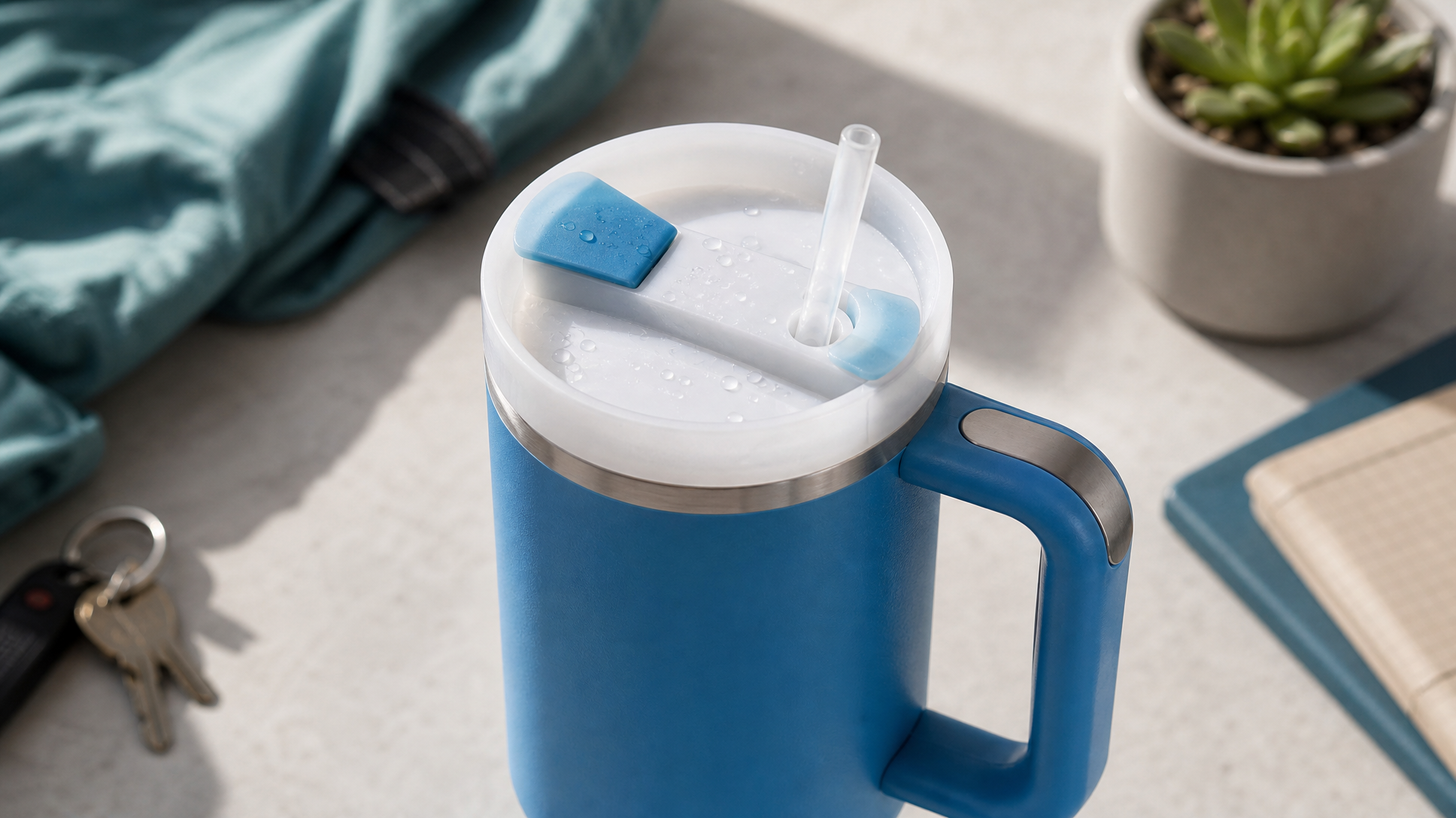
The Clean Hydration Co. Insulated Tumbler uses a spill-resistant flip-top lid that's designed with this in mind. The lid closes securely enough to be trusted in a bag or cupholder, while still being easy to flip open one-handed — which is the balance that's actually hard to strike.
3. The Lid-to-Body Seal
Even if the straw channel and flip-top are solid, a lid that doesn't seat firmly on the tumbler body creates its own leak path. This is usually a threading or press-fit issue. A lid that cross-threads easily, or one that feels secure but develops a gap when the tumbler flexes slightly, will let liquid escape around the rim — not through the straw mechanism at all.
This is why the wide opening on the Clean Hydration Co. tumbler matters beyond just cleaning convenience. A wider, more consistent rim is easier to seat a lid on correctly every time, which reduces the chance of a misaligned seal causing a slow drip.
What "Spill-Resistant" Actually Means (and What It Doesn't)
No travel mug with a straw is fully leakproof in every orientation. The straw has to open into the interior somehow, which means a fully inverted tumbler with an open straw channel will eventually let liquid through. "Spill-resistant" is the honest term, and it's the right expectation to have.
What spill-resistant means in practice: the lid handles the realistic accidents — a bag knocked off a desk, a cupholder tip, a tumbler on its side in a car. It doesn't mean you can shake it upside down like a cocktail shaker. If a brand claims otherwise, be skeptical.
The flip-top design addresses this directly. When the closure is shut, liquid has to overcome the seal resistance before it can reach the straw opening. In normal commuting and travel conditions, that's more than enough protection.
The Role of the Straw Itself
A reusable straw that comes with the tumbler isn't just a convenience feature — it's part of the seal system. A straw that's the right diameter and length for the specific lid it ships with will fit that straw channel properly. Replacing it with a generic straw from a drawer might introduce just enough size variation to compromise the seal.
The Clean Hydration Co. tumbler includes a clear reusable straw sized for its lid. If you ever need a replacement, match the diameter carefully rather than grabbing whatever's nearby.
Why the Interior Matters for a Travel Mug You'll Actually Use Daily
Lid design keeps the liquid in. The interior keeps the liquid tasting right. The Clean Hydration Co. tumbler uses a CeraTech™ ceramic-lined interior — which means no metallic aftertaste, even after hours of sitting. This matters more than people expect: a tumbler that keeps your coffee hot for hours but makes it taste faintly of metal isn't one you'll reach for every morning.
Combined with double-wall vacuum insulation for temperature retention, BPA-free materials, and the sturdy side handle visible on the mug, the design treats the drinking experience as a whole — not just the engineering problem of keeping liquid contained.
For a deeper look at how hydration habits connect to daily performance, the post on how water affects your brain is worth a read. And if you're figuring out how much you should actually be drinking throughout the day, the personalized hydration guide covers that in detail.
The Short Version, If You're Comparing Tumblers Right Now
When you're evaluating a leakproof travel mug with a straw, run through these three questions: Does the straw fit the port snugly with no lateral play? Does the flip-top close with a definite snap and stay closed under light pressure? Does the lid seat on the body cleanly, without wobble or cross-threading risk?
If the answer to all three is yes, you've found a lid design that will actually hold up to a commute. If a brand can't clearly describe how any of those three work, that's your answer too.
See the tumbler's lid design for yourself — shop the Clean Hydration Co. Insulated Tumbler in the Mugs collection and check out the full range of insulated drinkware while you're there.
Frequently Asked Questions
Is a travel mug with a straw lid truly leakproof?
Honestly, "spill-resistant" is the more accurate term for any travel mug that uses a straw. The straw requires an opening into the interior, which means a fully inverted mug can eventually let liquid through. What a well-designed flip-top straw lid does is handle real-world accidents — a tipped cupholder, a bag knocked over, a mug on its side — reliably and consistently.
The key is the quality of three things working together: the straw channel seal, the flip-top closure mechanism, and the lid-to-body fit. When all three are engineered properly, spill-resistant is genuinely protective for everyday commuting and travel use.
Can I use a different straw with my tumbler's lid?
You can, but match the diameter carefully. The straw that ships with a tumbler is sized specifically for that lid's straw port — a slightly narrower or wider aftermarket straw can introduce enough play in the channel to compromise the seal. If you need a replacement, look for one that matches the original's diameter as closely as possible rather than using a generic straw.
What is a ceramic-lined tumbler interior and why does it matter?
A ceramic-lined interior — like the CeraTech™ lining in the Clean Hydration Co. tumbler — coats the inside of the stainless steel body with a ceramic layer. This prevents the metal from coming into direct contact with your drink, which eliminates the metallic aftertaste that some people notice with traditional stainless steel tumblers.
For a travel mug you're using every day with coffee, tea, or water, taste neutrality makes a real practical difference. Your drink tastes like itself, not the container.
How do I clean a travel mug with a straw lid properly?
Disassemble the lid fully — remove the straw and, if possible, the flip-top closure — and clean each part separately. The straw channel is the spot most likely to harbor residue if you only rinse the assembled lid. A thin bottle brush or straw brush handles the straw itself. The wide opening on the Clean Hydration Co. tumbler makes cleaning the interior straightforward without needing specialized tools. For a full breakdown of best practices, the guide on how to clean your water bottle properly covers the details.